
 Dany
Dany Many people struggle to lose weight despite trying to eat healthy and exercise consistently. This is often due to unsustainable habits like strict dieting, overtraining, and all-or-nothing thinking. A more effective approach focuses on building simple, flexible habits that support long-term consistency, balanced nutrition, and realistic daily routines.
I spent years trying to “be healthy,” but nothing worked. If you’re struggling to find healthy habits for weight loss that actually stick, I’ve been there too.
Yet somehow I always felt off. My energy was stuck in a weird low gear, my mood was all over the place, and the scale rarely budged. If your healthy efforts feel like running on a hamster wheel, this might sound familiar.
Quick Take: Why My Healthy Routine Wasn’t Working (TL;DR)
Focusing on strict diets and intense workouts often leads to inconsistency and burnout rather than lasting results. Shifting to simple, sustainable habits, like balanced meals, enjoyable movement, and flexible routines, makes healthy living easier to maintain. Long-term weight loss works best when consistency and adaptability replace perfection and short-term extremes.
I went from strict diets and intense workout plans to focusing on habits, listening to my body, and enjoying food again. Making these changes turned healthy living from a battle into something that fits my actual life.
What’s On This Post
- Why I Couldn’t Lose Weight Despite Eating Healthy
- Healthy Habits for Weight Loss That Actually Work
- My Simple Daily Routine for Sustainable Weight Loss
- What Helped Me Keep It Real
- What I Did Before vs What I Do Now
- Encouragement If You’re Struggling
- Summary of Real World Changes
- Common Questions About Healthy Weight Loss Habits
- Health Is Simpler Than I Thought (And Way More Fun Now)
Why I Couldn’t Lose Weight Despite Eating Healthy
Many people struggle to lose weight despite “eating healthy” because of unsustainable habits like extreme restriction, overtraining, and all-or-nothing thinking. These approaches often lead to cycles of deprivation and overeating, making consistency difficult and preventing long-term progress in weight loss and overall health.
I thought healthy looked like never missing a workout and eating as “clean” as possible, basically forcing salads even when I was craving a sandwich. My week was a circus of plans: counting calories, meal prepping with zero flexibility, and if I “messed up,” cue the guilt. Before long, Friday night would roll around, and the “all or nothing” binge would follow. Then I’d beat myself up and start over Monday.
Most days, I was white-knuckling my way through cravings or “pushing myself” at the gym without any joy. I’d scroll social media, jealous of people who seemingly just lived healthy without all the drama. Deep down, I blamed myself for not trying hard enough.
The Change That Made the Difference
I hit a point where I just couldn’t do it anymore. It wasn’t one dramatic meltdown, just a slow realization that trying harder wasn’t the answer. I started reading about long-term change, and it clicked for me. I wasn’t failing – the system was. My mindset was all restriction and punishment, but never about building enjoyable routines. Healthy wasn’t about being perfect, it was about finding something you could actually do for the long term.
Turns Out, These “Healthy” Habits Held Me Back
- Chasing Perfection: Every slip-up felt like failure, so one missed workout could spiral into a full week “off track.”
- Overtraining: I’d cram in HIIT or long runs even when tired, thinking more sweat equals better results.
- Cutting All the Foods: Bread, sugar, dairy, you name it, I tried cutting it. The cravings always came back even stronger.
- Waiting for Motivation: Relying on hype to force myself never lasted, especially on stressful weeks.
- Only Calories Matter?: I got obsessed with calories in and calories out, ignoring how certain foods actually made me feel.
I see now those strategies did nothing for my energy, confidence, or peace of mind. If anything, they fueled my frustration and made consistency impossible.
Extreme dieting often leads to rebound overeating, making long-term weight loss harder.
I started noticing patterns, poor sleep led to cravings, and skipping meals made me overeat later. Paying attention to these patterns helped me adjust my habits without relying on strict rules.
Healthy Habits for Weight Loss That Actually Work
Sustainable weight loss comes from simple, repeatable habits rather than strict diets. Focusing on small daily actions, balanced meals with protein and fiber, enjoyable movement, and flexible routines helps reduce cravings, improve energy, and build consistency, making healthy habits easier to maintain long term.
- Little Habits, Big Difference: Instead of massive overhauls, I picked one or two behaviors and practiced until they felt natural. Drinking more water, adding veggies to meals, or walking 10 minutes a day felt doable. It snowballed from there.
- Ditching All-or-Nothing: If my meal wasn’t “perfect,” I let it go. Missed a workout? No guilt, just back at it tomorrow. Progress really does beat perfection, every single time.
- Making Satisfying Meals: I started putting together meals that left me full and happy, think protein, plenty of fiber, and a little healthy fat, so those wild snack cravings died down. While “low calorie” led to late-night eating before, balance actually made it easier to stop when I was full.
- Moving for Joy: I swapped high-intensity everything for movement I looked forward to: Pilates on tired days, walks outside with a podcast, a short strength session here and there. Suddenly it wasn’t a chore.
- Listening to My Body: Instead of chasing numbers on a scale or app, I started tracking energy, sleep, digestion, and mood. My body got subtle when I ate something that didn’t suit me or skimped on sleep, so I began following those clues. I was surprised by how much more in tune I felt.
After a few weeks, I noticed my energy stopped crashing in the afternoons.
5 Healthy Habits for Weight Loss That Actually Work
- Focus on small, consistent habits
- Let go of perfection
- Eat balanced, satisfying meals
- Move your body in ways you enjoy
- Pay attention to energy, sleep, and mood
What surprised me most was that trying less actually gave me better results.
I stopped trying to “be healthy” and started building what I now think of as a low-pressure health system.
My Simple Daily Routine for Sustainable Weight Loss
A sustainable weight loss routine includes consistent, low-effort habits like regular meals, daily movement, hydration, and quality sleep. Instead of strict schedules, flexible routines that adapt to energy levels and real-life situations help maintain long-term consistency and reduce the risk of burnout or relapse.
- Morning: Glass of water first thing, a simple breakfast (usually eggs and veggies or oatmeal), and a short stretch.
- During the Day: I try to eat every 3 to 4 hours (not “fasting” all morning only to be ravenous), focus on real food most of the time, and always include something I enjoy, hello, good bread or a little chocolate.
- Movement: I aim for 20 to 40 minutes a day, often just walking or gentle home workouts. No strict plan, I pick from what sounds good in the moment. That could be Pilates, a YouTube yoga flow, or strength training if I have extra pep.
- Evening: Big emphasis on winding down. Screens off after a certain hour, reading, or a warm shower. Sleep makes everything else much easier.
- The Mindset Piece: When I catch myself judging food as “bad” or “good,” I remind myself: it’s just food. My focus stays on patterns, not perfection.
This isn’t a routine I dread or feel forced to stick to. Honestly, it finally feels like something I can picture doing for years, not just a few frantic weeks.
Meals with protein, fiber, and healthy fats help keep you full longer and reduce cravings.
I gave myself a “minimum baseline”, even on low-energy days, I would still do something small, like a 10-minute walk or a simple meal. That kept me consistent.
Meals with protein, fiber, and healthy fats help regulate hunger and reduce cravings throughout the day.
The 3 Rules I Followed (That Changed Everything)
- Rule 1: Never skip twice
- Rule 2: Make it easy on low-energy days
- Rule 3: Focus on patterns, not single days
What Helped Me Keep It Real
Long-term success in healthy habits often comes from accepting imperfection and focusing on consistency over time. Allowing flexibility for real-life situations, tracking how the body feels instead of only numbers, and building forgiving routines makes it easier to stay on track without falling into cycles of guilt or quitting.
I didn’t wake up one day suddenly “healthy.” My progress came slow, sometimes boring, and with plenty of messy days. But after a few months, I realized I wasn’t thinking about food all the time, my mood swings calmed down, and even my weight changed (almost as a side effect). The difference wasn’t in my willpower, it was that what I was doing finally fit into my real, unpredictable life. That made all the difference for sustainable weight loss too.
Something that surprised me was how much easier it became to handle surprise events, like takeout nights or skipped workouts, once my habits were more forgiving. When you expect some ups and downs, it’s easier to roll with real life. Checking in with how I felt each day (instead of just tracking numbers) gave me a roadmap for what needed a little more attention.
The Simple Habit Reset Method I Used
Instead of trying to fix everything at once, I followed a simple 3-part system that made healthy habits actually stick:
1. Reduce Friction
Make habits easier (short walks, simple meals)
2. Remove Extremes
No more all-or-nothing dieting or overtraining
3. Repeat Consistently
Focus on showing up, not doing it perfectly
Extreme dieting often leads to cycles of restriction and overeating, which can make long-term weight loss harder.
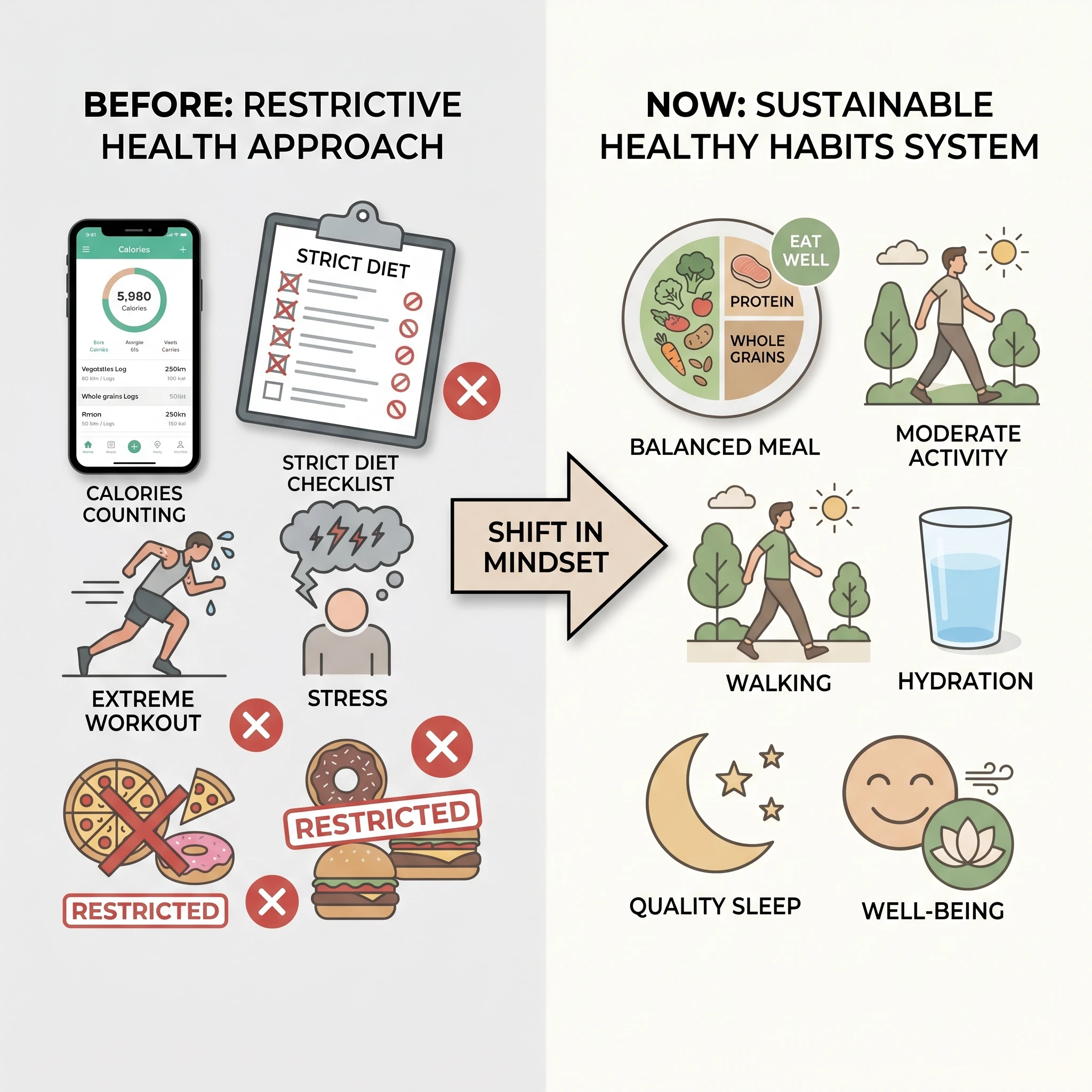
What I Did Before vs What I Do Now
Many people struggle with weight loss because they rely on strict diets, intense workouts, and all-or-nothing thinking. Shifting to balanced meals, regular eating patterns, flexible movement, and consistent habits creates a more sustainable approach. This change reduces burnout and makes it easier to maintain healthy behaviors long term.
Before:
- Strict diets
- Skipping meals
- Intense workouts only
- All-or-nothing mindset
Now:
- Balanced meals
- Regular eating
- Flexible movement
- Consistent habits
| Area | Before (Restrictive Approach) | Now (Sustainable Approach) |
|---|---|---|
| Mindset | All-or-nothing thinking, pressure to be perfect | Flexible mindset focused on consistency, not perfection |
| Dieting Style | Strict diets, cutting entire food groups | Balanced meals with protein, fiber, and healthy fats |
| Exercise | Intense workouts, HIIT even when exhausted | Enjoyable movement like walking, Pilates, and light strength training |
| Motivation | Relying on motivation and discipline | Building habits and routines that run automatically |
| Food Relationship | Food guilt, labeling foods as “good” or “bad” | Neutral approach to food, no guilt or restriction mindset |
| Consistency | Frequent burnout and restarting cycles | Steady, sustainable routines with room for flexibility |
| Tracking | Obsessing over calories and weight scale | Listening to energy, sleep, digestion, and mood |
| Lifestyle Outcome | Frustration, low energy, inconsistency | Better energy, improved mood, and sustainable progress |
Encouragement If You’re Struggling
If healthy habits aren’t sticking, the issue is often the approach rather than effort. Simplifying routines, focusing on small, enjoyable changes, and removing pressure to be perfect can make healthy living more sustainable. Consistency with flexible habits is more effective than strict diets or short-term challenges.
If you’re stuck in that cycle of “trying to be healthy” but nothing seems to stick, I promise, it might just be the approach, not your effort. You don’t need more discipline. You probably just need to shrink your to-do list and make the whole thing a little more forgiving. Tiny, enjoyable changes add up way more than any crash diet or 75-hard challenge ever will. This time around, fun and flexibility were key ingredients for me.
Don’t underestimate the power of making health feel enjoyable. For me, changing my playlist during walks or experimenting with new flavors helped keep everyday habits interesting. Sometimes, adding a small reward, like relaxing with a book after a workout, was the nudge I needed to stick with it.
Summary of Real World Changes
Shifting from restriction and perfectionism to balance and self-awareness can significantly improve energy, mood, and weight management. Prioritizing sustainable habits over quick results helps create a healthier lifestyle that feels natural and maintainable rather than forced or temporary.
I swapped restriction for balance, overtraining for enjoyable movement, and food guilt for selfawareness. The focus moved from losing weight at all costs to building a healthy life I actually want to live. Now I feel more energized, clearheaded, and confident, instead of always chasing the next promise of fast results. What seemed impossible for years started falling into place once I stopped trying to be perfect.
Common Questions About Healthy Weight Loss Habits
Healthy weight loss is best achieved through consistent habits like balanced eating, enjoyable movement, and flexible routines. Avoiding extreme restriction and focusing on long-term behaviors helps prevent cycles of overeating and burnout, making results more stable and sustainable over time.
Why am I not losing weight despite eating healthy?
My old “all or nothing” tactics led to cycles of deprivation and overeating. My body always rebelled after too much restriction, making it hard to lose weight or keep it off. Once I focused on habits I could stick with, my results finally became steady.
What are healthy habits for weight loss that actually last?
Building meals with enough protein, fiber, and healthy fats kept me full. Scheduling movement I enjoyed, not dreaded, helped me stay active. Planning for fun and flexibility meant I stopped rebounding into old habits.
How did you get over food guilt?
I reminded myself every day: one meal or snack never ruins everything. The goal is more good habits than not so great ones over time. Being kind to myself actually helped me stay on track.
How do you stay motivated to be healthy?
The truth is, motivation fades, habits last. I built routines into my day, and when I fall off, I just return without the drama. I trust the process much more than any quick fix now. Looking for enjoyment in my routines gave me more staying power than just relying on discipline.
Health Is Simpler Than I Thought (And Way More Fun Now)
Health becomes more manageable when approached with simplicity and flexibility rather than strict rules. Small, consistent habits, combined with patience and self-awareness, create sustainable progress. This approach reduces stress and makes it easier to maintain a healthy lifestyle long term.
For a long time, I made health way harder (and more miserable) than it needed to be. What really mattered: patience, flexibility, and staying curious about what my unique body needs. My take is, being healthy doesn’t look the same for everyone. I actually enjoy food and movement now. If you’re tired of fighting your body, I challenge you to try the small, steady approach. Ditch the guilt trips and complicated rules. Consistency is quiet, steady, and usually looks unexciting from the outside. But it absolutely works in real life.
As life keeps moving and things change, the smallest sustainable tweaks really do add up. Give yourself permission to try less, but smarter. Enjoy your food, give your body rest, and let your healthy habits grow naturally. Life and health are too short for never-ending diets.
Want new food hacks and smart, balanced ways to reach your health goals? Join my “Weightletics” publication for more real life tips about sustainable weight loss, movement, and living well, just pop your email address in to stay in the loop.
If this post helped you, save it or share it with someone who’s tired of starting over every Monday.
Want more simple strategies?














I really enjoyed reading this because the focus on simple and sustainable habits feels much more realistic than following strict diets. I agree that consistency, balanced nutrition and flexible routines can make healthy weight management easier to maintain. Small changes such as improving meal quality, including enough protein and fibre, staying active and avoiding an all-or-nothing mindset can make a big difference over time. Thank you for sharing such a relatable and practical perspective on sustainable weight loss.
I’m so glad you enjoyed the article and found the information valuable. I really appreciate your comment!