
 Dany
Dany Running and cycling are two of the most effective cardio exercises for fat loss, but which one actually burns more fat? While running generally burns more calories per minute, cycling allows longer workouts with less stress on your joints. In this guide, you’ll discover how each exercise compares for calorie burn, muscle building, injury risk, and long-term weight loss so you can choose the best option for your goals.
Running and cycling are two of the most popular ways to burn fat, lose weight, and stay fit. Both serve as go-to cardio exercises for people looking to shed pounds or boost their cardiovascular health. If you’re trying to figure out whether running or cycling is more effective for burning fat, you’re definitely not alone. The short version: running tends to burn more calories in less time, but cycling can be easier to stick with for longer periods and is a lot more comfortable for your joints. Here’s how the two stack up, what actually works for fat loss, and how to pick the option that’s right for your lifestyle and goals.
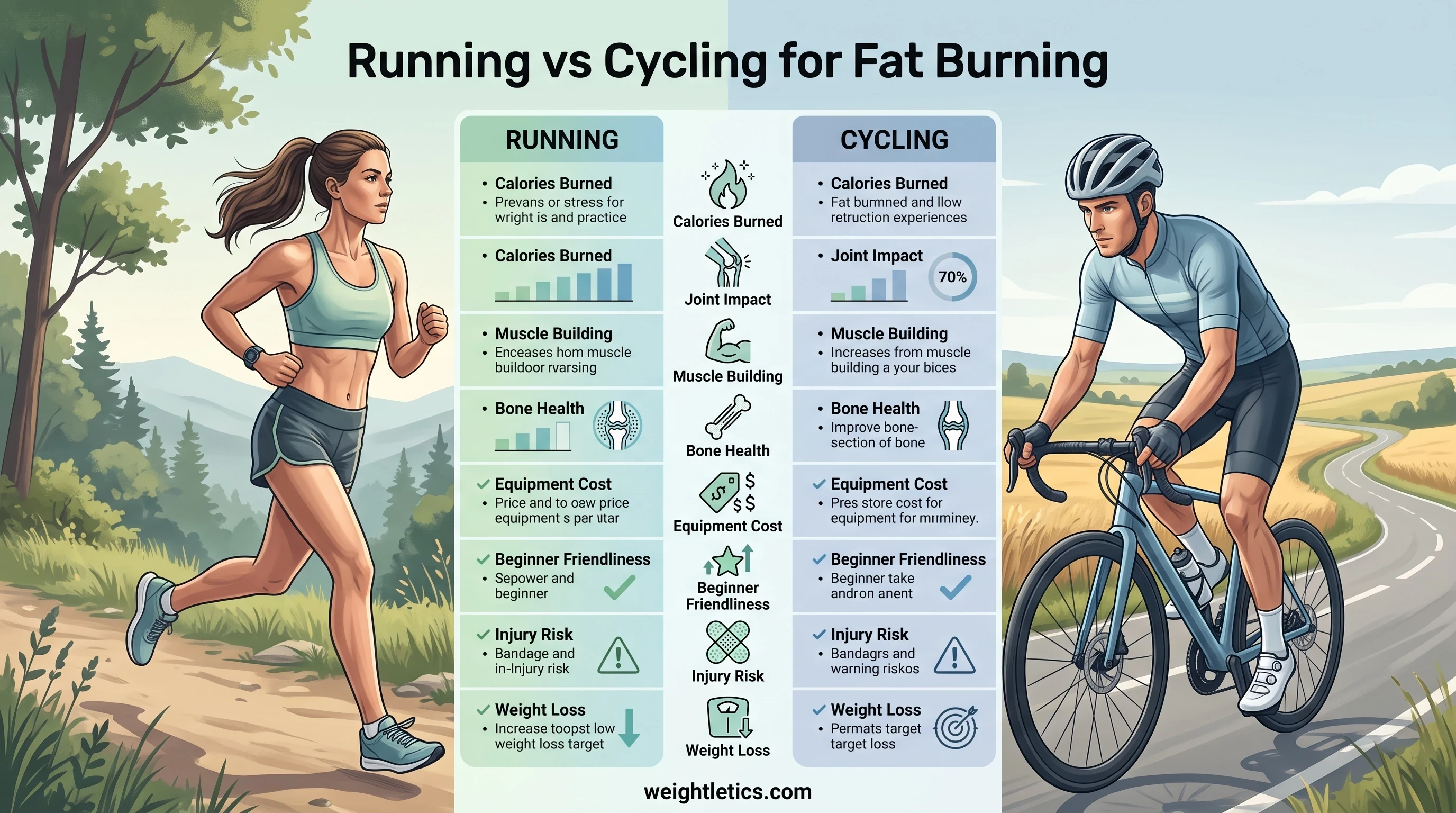
| Feature | Running | Cycling |
|---|---|---|
| Calories burned | High | High/Medium |
| Fat burning | High | High/Medium |
| Joint impact | High | Low |
| Muscle building | Lean muscle | Larger leg muscles |
| Bone health | Excellent | Limited |
| Injury risk | Higher | Lower |
| Beginner friendly | Moderate | Excellent |
| Equipment cost | Low | Higher |
TL;DR
Running burns more calories per minute, while cycling is lower impact and easier to sustain for longer workouts. Both support fat loss when paired with a calorie deficit, and combining the two often delivers the best balance of fitness, recovery, and long-term consistency.
Quick highlights:
- Best for calorie burn: Running
- Best for joint health: Cycling
- Best for leg muscle development: Cycling
- Best for bone health: Running
- Best for sustainable fat loss: The exercise you’ll do consistently
- Best overall: Combine running and cycling for balanced fitness
- How Fat Burning Really Works
- Running Vs. Cycling: Which Burns More Calories?
- Does Cycling Build Muscle or Burn Fat?
- Does Running for 30 Minutes Burn Fat?
- Will I Lose Belly Fat If I Jog Every Day?
- Muscle Building: Running Vs. Cycling
- Running Vs. Cycling: Which Is Better for Bone Health?
- Which Exercise Is Better for Beginners?
- Running Vs. Cycling: Equipment and Cost
- Joint Health and Injury Risk
- Why Combining Running and Cycling May Be the Best Option
- Which Is Better for Weight Loss?
- Tips to Burn More Fat Whether You Run or Cycle
- Which Exercise Fits Your Goal?
- Which Should You Choose?
- Frequently Asked Questions
- Key Takeaways
- Final Verdict
- References
How Fat Burning Really Works
Fat burning occurs when your body uses stored fat for energy because you’re consistently burning more calories than you consume. While both running and cycling increase calorie expenditure, long-term fat loss depends on maintaining a calorie deficit, eating enough protein to preserve muscle, and exercising consistently.
The whole idea behind fat burning centers around a calorie deficit. Basically, if you eat fewer calories than you burn, through daily living and workouts, your body will start using stored fat for energy. But just working out isn’t enough.
If you’re eating more calories than you use, it won’t matter how often you hit the pavement or the bike path, fat loss just won’t happen.

Busting another common myth: burning calories doesn’t always mean burning fat. Your body first uses up easy-access energy like carbs in your bloodstream or muscle glycogen, so you need to create a consistent deficit over time to really dig into those stubborn fat stores.
Consistency is the real game changer. Regular workouts paired with pretty balanced nutrition set the stage for steady progress.
Protein helps keep muscle on (super important for fat loss), and eating whole foods most of the time keeps your body fueled and recovery on track.
Read more: International Society of Sports Nutrition (ISSN) Position Stand on Protein and Exercise
Running Vs. Cycling: Which Burns More Calories?
Running generally burns more calories per minute than cycling because it is a weight-bearing exercise that recruits more muscles at the same intensity. However, longer or higher-intensity cycling sessions can match or exceed running’s total calorie burn, making both effective options for fat loss.
Here’s where things get interesting. In most situations, running torches more calories per minute than cycling, especially if you’re going at a brisk pace. For example, a person weighing about 155 pounds (70 kg) will burn roughly 298 calories in 30 minutes of running at 6 mph (10 kph), while cycling at a moderate pace for the same duration burns about 260 calories.
Read more: Compendium of Physical Activities
Best for burning calories quickly: Running
Best for longer workouts: Cycling
Best overall: Running for efficiency, cycling for endurance.
Factors That Affect Calorie Burn
- Body weight: Heavier people generally burn more calories during both running and cycling.
- Intensity: The harder you work, the more calories you’ll burn.
- Terrain: Hills and uneven trails require more energy than flat surfaces.
- Speed: Faster running or cycling increases calorie expenditure.
- Workout duration: Longer sessions can significantly increase total calories burned.
- Fitness level: As your fitness improves, you may need to increase intensity to continue challenging your body.

Quick Takeaway
Running burns more calories per minute than cycling, making it the more time-efficient option for fat loss. However, longer or more intense cycling sessions can burn just as many, or even more, total calories while putting less stress on your joints.
Although running is a calorie-burn powerhouse, longer cycling sessions, even at lower intensity, can match or top the number of calories you’d burn running for a shorter period. This is why cycling marathons or long weekend rides can be a serious fat-burning tool.
Does Cycling Build Muscle or Burn Fat?
Cycling supports both fat loss and muscle development. It burns calories to help create a calorie deficit while strengthening the quadriceps, glutes, hamstrings, and calves. Combining cycling with resistance training and adequate protein helps maximise muscle retention during weight loss.
Cycling definitely helps you burn fat, but there’s another bonus: it builds muscle at the same time, especially in your legs and glutes. Those steady pedal strokes target your quadriceps (front thigh), glutes (butt), hamstrings (back thigh), and calves.
Best for building leg muscles: Cycling
Best for preserving muscle during weight loss: Cycling combined with strength training
Remember: Fat loss still depends on maintaining a calorie deficit.
Muscles Primarily Worked During Cycling
- Quadriceps
- Glutes
- Hamstrings
- Calves
- Hip flexors
- Core muscles for stability
Outdoor cycling is a little different from using a stationary bike, mainly because dealing with hills, wind, and resisting gravity gives your muscles a bit more work.
Adding resistance, by cranking up the difficulty on a stationary bike or taking hilly outdoor routes, increases muscle engagement and will help you preserve, or even grow, leg muscles while you trim down.
Quick Takeaway
Cycling helps burn fat and strengthen your lower-body muscles at the same time. For the best results, combine regular cycling with strength training and a calorie-controlled diet.
If you’re looking for better definition in your legs, cycling’s repetitive motion naturally strengthens those large muscle groups. Over time, this can lead to better balance, stronger joints, and a boost in overall metabolism.
Combining cycling with a touch of strength training, like squats or lunges, really gives your lower half the full package of strength and endurance gains.
Does Running for 30 Minutes Burn Fat?
Yes. Running for 30 minutes can support fat loss by increasing calorie expenditure. Depending on your body weight and pace, a 30-minute run typically burns between 250 and 400 calories. Consistent running combined with a balanced diet produces the best long-term results.
Running for 30 minutes consistently can definitely help with fat loss, as long as your overall calorie intake supports it. For most people, a half hour of running burns between 250 and 400 calories, depending on speed and body size.
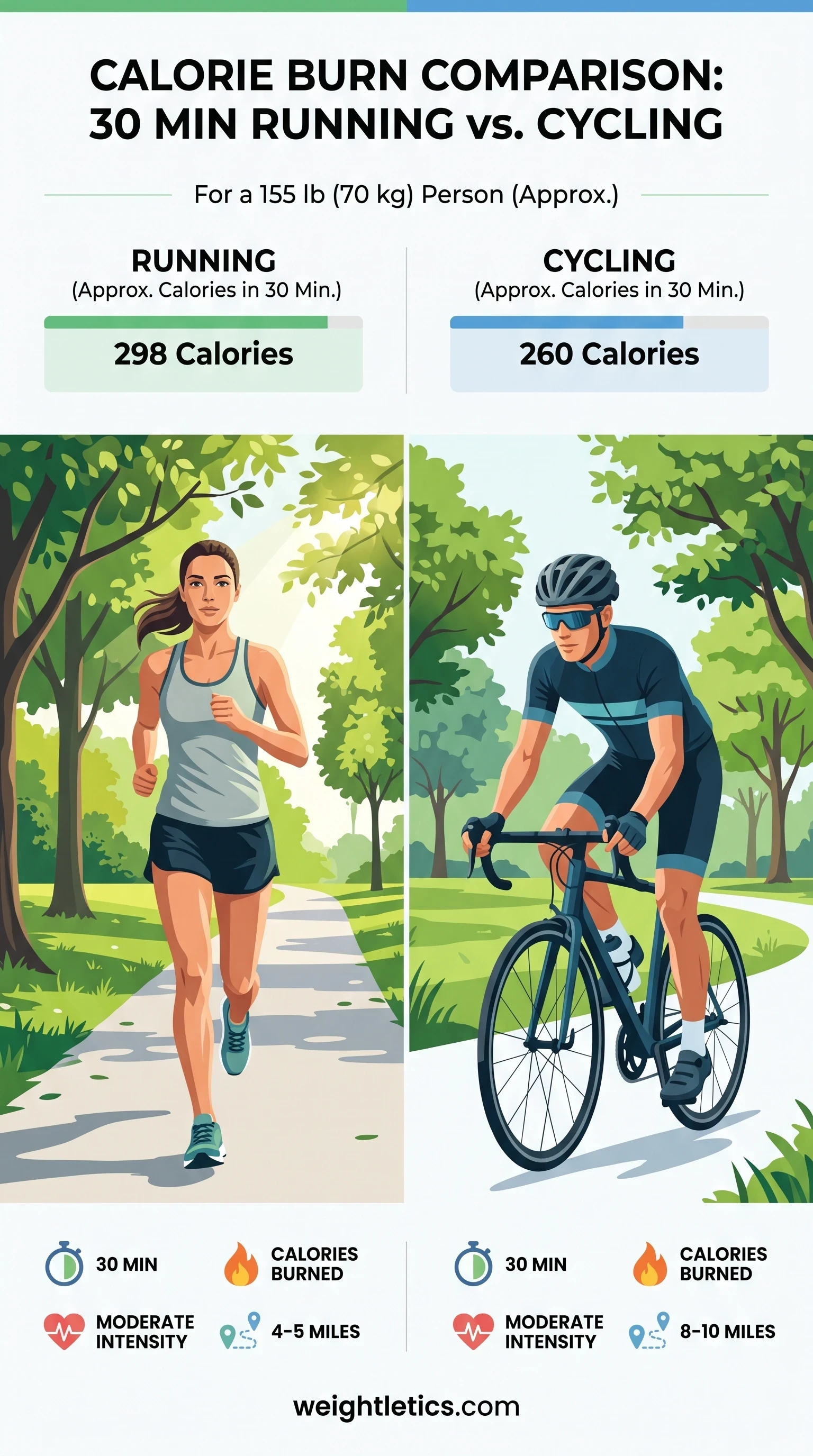
Average Calories Burned in 30 Minutes (155-pound / 70-kg person)
- Walking: Approximately 150 calories
- Jogging: Approximately 230–298 calories
- Running: Approximately 300–400+ calories
Good for: Busy schedules
Typical calorie burn: Around 250–400 calories in 30 minutes
Most important factor: Consistency over intensity
Quick Takeaway
A 30-minute run can support fat loss by increasing calorie expenditure. The greatest results come from running consistently while maintaining a sustainable calorie deficit through healthy eating habits.
Going harder burns more, but a moderate, steady pace, if done regularly, is just as useful for long-term fat loss. There’s a lot of hype about fasted running (doing cardio before breakfast) for fat burn, but research shows it doesn’t make a big difference overall.
What matters more is showing up consistently and sticking with a calorie-friendly diet.
During sustained training, I often replaced easy recovery runs with cycling to maintain aerobic fitness while reducing impact on my knees.
If you find yourself short on motivation, try running with a group or signing up for a local race. Having others to keep you moving makes it more fun and can lead to better long-term results.
Will I Lose Belly Fat If I Jog Every Day?
Jogging regularly can help reduce belly fat, but it cannot target fat loss in one specific area. As your overall body fat decreases through consistent exercise and a calorie deficit, your waistline will gradually become leaner over time.
Jogging every day might slim down your waist, but spot reduction (burning fat from just one body part, like your belly) just isn’t how the body works. Fat loss happens throughout your whole body as your overall fat stores drop.
Myth: You can’t target belly fat with a specific exercise.
Reality: Overall body fat decreases first, and belly fat reduces over time.
Best strategy: Jog regularly, eat well, and be patient.
Jogging contributes to a calorie deficit, so as your overall body fat decreases, your belly fat will go too, just maybe not as fast as you’d like. Nutrition is honestly the big player here. If you get your food right and jog often, you’ll notice your waistline shrinking.
Signs You May Need More Recovery
- Constant muscle soreness
- Trouble sleeping
- Persistent fatigue
- Declining performance
- Loss of motivation
- Frequent minor injuries
Quick Takeaway
Jogging can help reduce belly fat over time, but it won’t target fat around your stomach specifically. Overall fat loss depends on consistent exercise, balanced nutrition, and patience.
Building in a few recovery days each week really matters too. Overtraining can backfire, causing injuries or just burning you out mentally. Some signs you’re pushing too hard include trouble sleeping, constant soreness, or feeling worn out all day.
Muscle Building: Running Vs. Cycling
Cycling generally builds more lower-body muscle because of its continuous resistance, while running develops lean muscle, muscular endurance, and core stability. Both activities help preserve muscle during weight loss when combined with strength training and sufficient protein intake.
Running will help you build lean, toned muscles in your legs and core. Most runners, especially those doing long distances, end up with a slimmer, athletic build rather than bulky legs.
Cycling, on the other hand, encourages larger leg muscles, especially if you use a lot of resistance or tackle lots of hills.
If you’re focused on retaining muscle while losing fat, cycling may give you the edge just because it’s easier to make it a lower-impact, longer session, which is helpful for burning off fat without breaking down muscle.
The real trick, for both sports, is adding some strength training. Two to three sessions a week is usually enough to keep muscles strong and your metabolism firing, no matter which cardio you do more often.
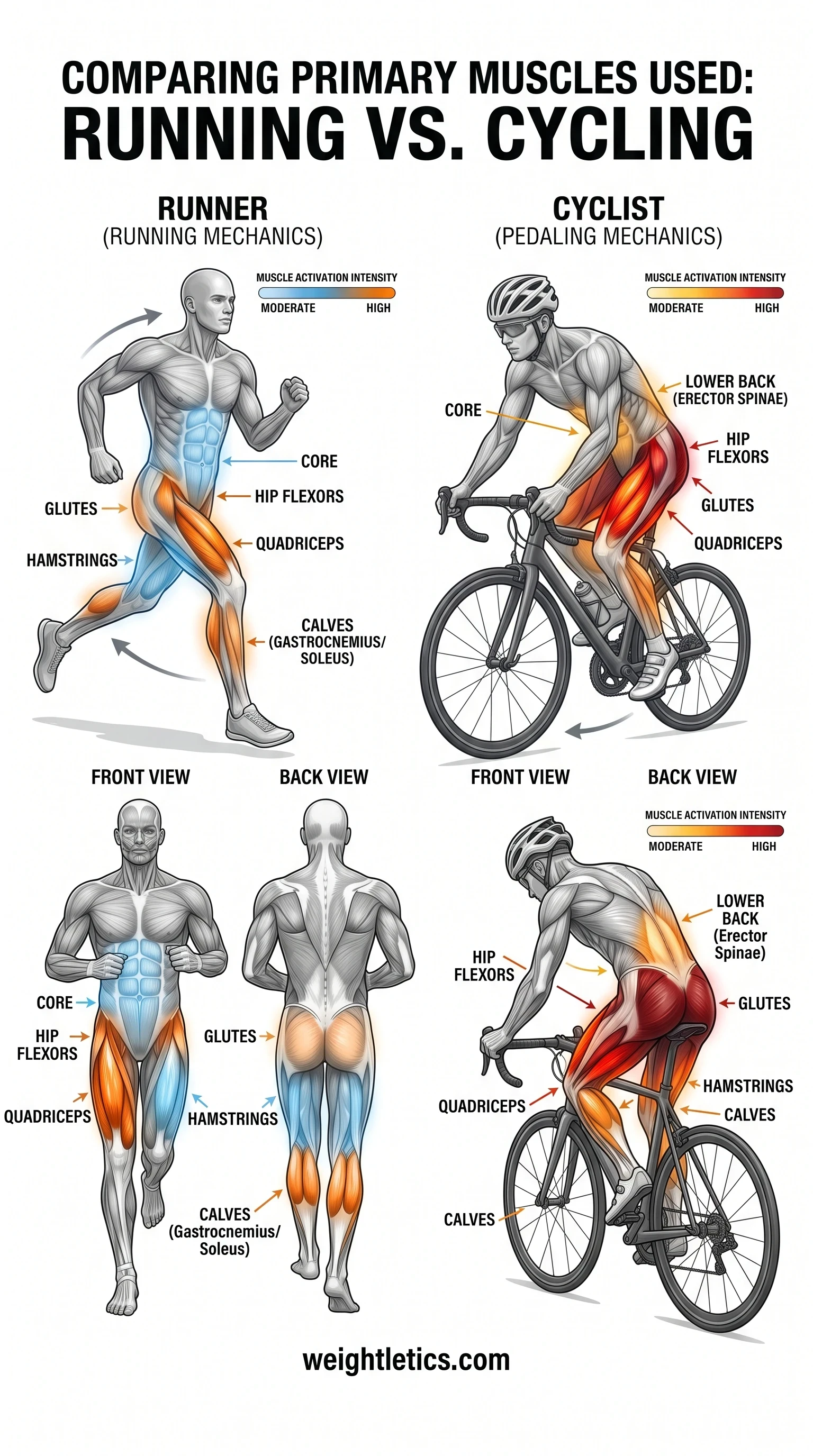
Running Helps Develop
- Lean leg muscles
- Core stability
- Muscular endurance
- Cardiovascular endurance
Cycling Helps Develop
- Quadriceps
- Glutes
- Hamstrings
- Calves
- Lower-body strength
Quick Takeaway
Running develops lean muscle and muscular endurance, while cycling is more effective for building strength and size in the legs. Adding strength training enhances the benefits of both.
Best for lean muscle: Running
Best for stronger legs: Cycling
Best results: Combine cardio with strength training.
Remember, both running and cycling also work your core muscles, helping your posture and overall functional strength. Switching up these workouts with activities like swimming or hiking can offer more variety and help keep progress steady.
Running Vs. Cycling: Which Is Better for Bone Health?
Running is better for bone health because it is a weight-bearing exercise that stimulates bone remodelling and improves bone density. Cycling offers excellent cardiovascular benefits but provides little bone-loading stimulus, making resistance training an important complement for cyclists.
When it comes to bone health, running has a clear advantage because it’s a weight-bearing exercise. Every stride places gentle stress on your bones, encouraging them to become stronger over time.
This process, known as bone remodeling, helps maintain bone density and may reduce the risk of osteoporosis as you age.
Cycling, on the other hand, is a non-weight-bearing activity. While it’s excellent for improving cardiovascular fitness, burning calories, and strengthening your leg muscles, the bike supports most of your body weight.
As a result, cycling doesn’t stimulate bone growth to the same extent as running.
This doesn’t mean cyclists have poor bone health, it simply means they may benefit from including strength training or other weight-bearing exercises, such as walking, hiking, or resistance training, in their weekly routine to help maintain strong bones.
Best for bone density: Running
Best for joint-friendly cardio: Cycling
For optimal bone health: Include resistance training alongside cycling
Quick Takeaway
Running supports stronger bones because it’s a weight-bearing activity, whereas cycling provides excellent cardiovascular benefits but little stimulus for improving bone density.
If you’re recovering from an injury or have joint pain, cycling remains an excellent choice because it allows you to stay active with minimal impact.
However, if improving bone health is one of your fitness goals, incorporating some weight-bearing exercise alongside cycling can provide the best of both worlds.
Bone Health Comparison
Running
- Weight-bearing exercise
- Improves bone density
- Supports long-term bone health
Cycling
- Non-weight-bearing exercise
- Minimal bone-loading stimulus
- Best combined with resistance training
Bone Health at a Glance
- Running: Improves bone density through weight-bearing impact.
- Cycling: Excellent for cardiovascular fitness but provides little stimulus for bone growth.
- Best approach: Combine cycling with strength training or other weight-bearing activities to support long-term bone health.
Which Exercise Is Better for Beginners?
Cycling is often the better choice for beginners because it is low impact and places less stress on the joints. Running is ideal for people seeking a simple, affordable workout that burns more calories in less time and requires minimal equipment.
If you’re carrying extra weight or dealing with joint pain, cycling is probably the easier route to start. It’s low impact, meaning it’s kinder on your knees, hips, and ankles. You can ride indoors or outdoors, making it great year round.
Running is more straightforward. Lace up your shoes, step outside, and go. For some people, this simplicity keeps them coming back for more.
But if you’re dealing with joint pain or looking for a workout that’s easier to recover from, cycling gets the nod.
One pattern I frequently see with beginners is that they abandon running within a month because they start too fast. Cycling often provides a gentler entry point that helps build consistency before introducing running.
Running May Be Better If You
- Want a simple workout
- Have limited time
- Enjoy exercising outdoors
- Want maximum calorie burn
Cycling May Be Better If You
- Have joint pain
- Are overweight
- Prefer low-impact exercise
- Want easier recovery
- Enjoy longer workouts
Quick Takeaway
Cycling is usually the easier starting point for beginners because it’s low impact and easier on the joints. Running is a great choice if you’re looking for a simple, affordable workout that burns more calories in less time.
If you’re new to exercise: Start with cycling if you have joint concerns.
If you want simplicity: Choose running.
Either option works: The best choice is the one you’ll enjoy and maintain.
If you have any preexisting health concerns, a quick chat with your doctor before starting a new routine is always a smart idea
They can offer guidance for getting started safely and help you make the most of whichever activity you choose.
Running Vs. Cycling: Equipment and Cost
Running is generally more affordable because it requires little more than supportive running shoes. Cycling has a higher upfront cost due to the bike, helmet, and maintenance, but it can also serve as transportation and a long-term recreational activity.
Cost can play a bigger role in your fitness journey than you might expect, especially when choosing an exercise you can stick with for years.
Running is generally the more affordable option. To get started, all you really need is a good pair of running shoes that fit well and provide adequate support. While many runners eventually invest in items like moisture-wicking clothing, fitness watches, or hydration gear, these are optional rather than essential.
Cycling typically requires a larger upfront investment. At a minimum, you’ll need a bicycle and a properly fitted helmet. Many cyclists also purchase accessories such as bike lights, a repair kit, water bottle cages, padded shorts, cycling shoes, and a bike lock. On top of that, regular maintenance, such as replacing tyres, brake pads, chains, and servicing the bike, adds to the long-term cost.
Quick Takeaway
Running requires very little equipment, making it one of the most affordable forms of exercise. Cycling involves a higher upfront investment but can also double as transportation and a recreational activity.
That said, many people find cycling worth the investment because it’s not only a form of exercise but also a practical way to commute, explore new places, or enjoy time outdoors. If you use your bike for transportation as well as fitness, the overall value can outweigh the higher initial expense.
Lowest cost: Running
Highest initial investment: Cycling
Best long-term value: The activity you’ll use consistently.
Running Essentials
- Running shoes
- Comfortable clothing
- Water bottle (optional)
- Fitness watch (optional)
Cycling Essentials
- Bicycle
- Helmet
- Bike lock
- Water bottle
- Lights
- Repair kit
- Pump
- Cycling shorts (optional)
Equipment and Cost at a Glance
| Running | Cycling |
|---|---|
| Lower upfront cost | Higher upfront cost |
| Requires only quality running shoes | Requires a bicycle and helmet |
| Minimal ongoing expenses | Regular maintenance and replacement parts |
| Easy to start almost anywhere | Requires storage and transport considerations |
Ultimately, the best choice is the one that fits both your budget and your lifestyle. An exercise that’s affordable, convenient, and enjoyable is far more likely to become a long-term habit, which is what leads to lasting fat loss and better overall health.
Joint Health and Injury Risk
Cycling is easier on the joints because it is a low-impact exercise, while running exposes the body to greater impact forces that can increase the risk of overuse injuries. Proper progression, recovery, and technique reduce injury risk in both activities.
Running has a higher chance of injuries, particularly to your lower body. Common issues are shin splints, runner’s knee, IT band pain, and even stress fractures, especially if you ramp up mileage too fast or skip recovery days.
Cycling comes with its own set of challenges, mainly saddle soreness, occasional lower back pain (if your bike fit isn’t quite right), and neck or wrist discomfort on longer rides.
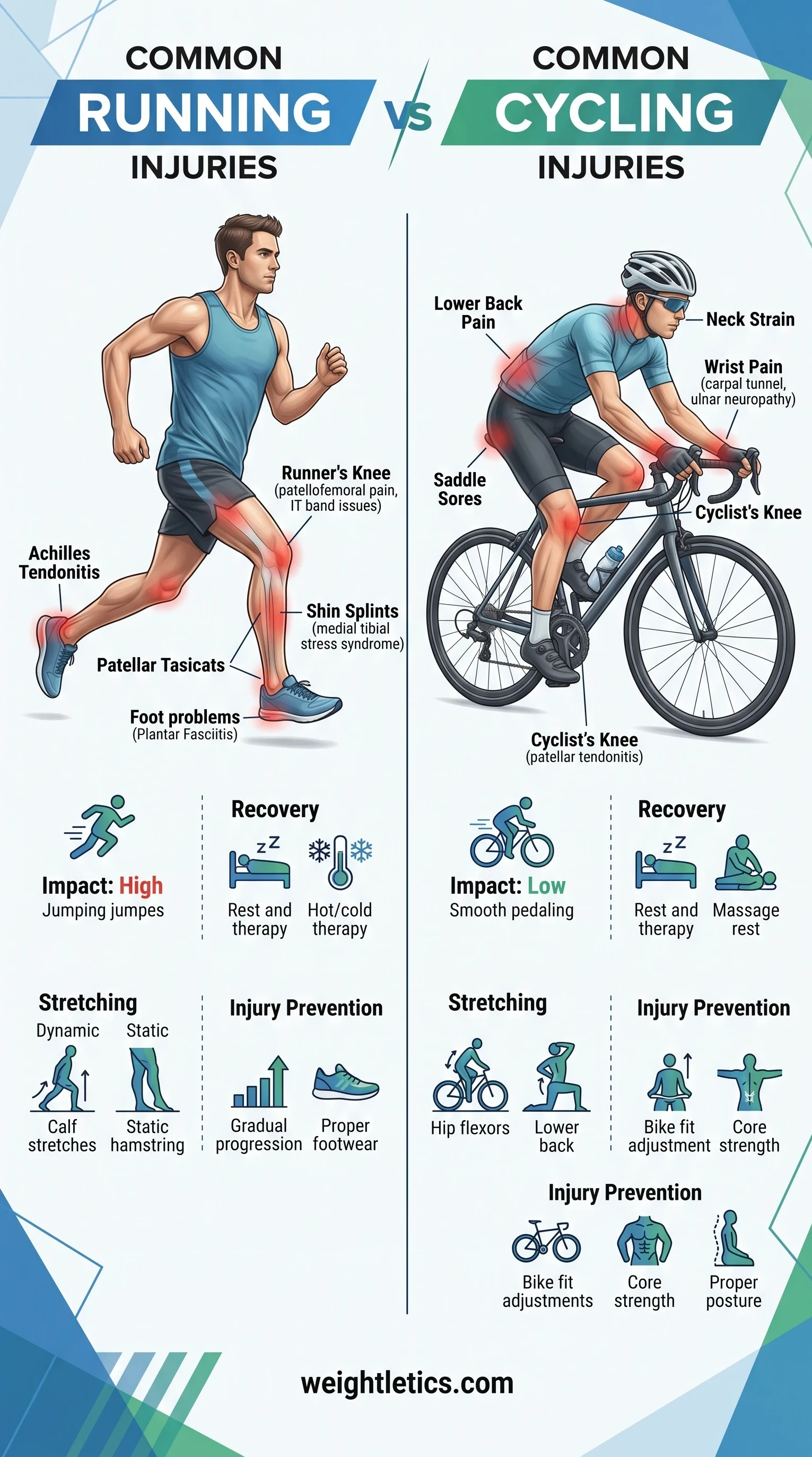
Lower injury risk: Cycling
Higher impact: Running
Reduce your risk: Increase training gradually and prioritise recovery.
Common Running Injuries
- Runner’s knee
- Shin splints
- IT band syndrome
- Achilles tendinitis
- Plantar fasciitis
- Stress fractures
Common Cycling Issues
- Saddle soreness
- Lower back pain
- Neck stiffness
- Wrist discomfort
- Knee pain from poor bike fit
Quick Takeaway
Cycling places less stress on your joints and generally carries a lower risk of impact-related injuries. Running strengthens bones but requires proper training and recovery to reduce the risk of overuse injuries.
But the actual impact on joints is minimal, making it safer for long-term use, especially as you get older or if you’re recovering from previous injuries.
Proper warm-up routines before each session, along with stretching, can help keep injuries at bay regardless of which routine you pick. Don’t forget to listen to your body and ease up if something feels off.
Why Combining Running and Cycling May Be the Best Option
Combining running and cycling provides the benefits of both activities by increasing calorie expenditure, reducing repetitive stress, improving cardiovascular fitness, and lowering the risk of overuse injuries. Cross-training also adds variety, making long-term exercise habits easier to maintain.
You don’t necessarily have to choose between running and cycling. In fact, many recreational exercisers, endurance athletes, and even elite runners combine both activities to enjoy the unique benefits each offers.
Running is excellent for maximizing calorie burn, improving bone health, and building cardiovascular fitness.
Cycling complements it by providing a low-impact workout that lets you continue training while giving your joints, tendons, and muscles a chance to recover from the repeated impact of running.
Alternating between the two can also reduce your risk of overuse injuries, which often develop when the same muscles, joints, and movement patterns are stressed day after day.
Quick Takeaway
Combining running and cycling gives you the benefits of both activities, higher calorie burn, lower injury risk, improved recovery, and greater workout variety for long-term consistency.
By varying your workouts, you challenge your cardiovascular system while spreading the workload across different muscle groups.
Cross-training can also make your fitness routine more enjoyable. Instead of repeating the same workout every day, you can choose the activity that best matches your energy levels, the weather, or your recovery needs.
Many people find that this variety helps them stay motivated and consistent over the long term.
Why Cross-Training Works
- Uses different muscle groups
- Reduces repetitive stress
- Improves overall fitness
- Supports active recovery
- Helps prevent boredom
- Makes training more sustainable
Benefits of Combining Running and Cycling
- Increases overall calorie expenditure without adding excessive impact.
- Reduces the risk of overuse injuries by varying movement patterns.
- Gives joints and connective tissues time to recover between runs.
- Maintains cardiovascular fitness even when you’re unable to run.
- Strengthens muscles in slightly different ways for more balanced fitness.
- Adds variety to your routine, helping prevent boredom and burnout.
- Makes it easier to train consistently throughout the year.
Sample Weekly Cross-Training Plan
If your goal is fat loss, a balanced weekly routine might look like this:
| Day | Workout |
|---|---|
| Monday | 30–45 minute run |
| Tuesday | 45–60 minute cycling session |
| Wednesday | Full-body strength training |
| Thursday | Interval run or hill repeats |
| Friday | Easy recovery ride |
| Saturday | Long run or long bike ride |
| Sunday | Rest, walking, or mobility work |
This combination provides plenty of cardiovascular exercise while allowing different muscles and joints to recover between harder sessions.
Best for variety: Combine both.
Best for injury prevention: Cross-train.
Best for long-term consistency: Alternate running and cycling throughout the week.
The Bottom Line
For many people, the question isn’t running or cycling, it’s how to use both effectively. Running offers a higher calorie burn in less time, while cycling allows you to train longer with less impact. Combining the two can improve fitness, support sustainable fat loss, reduce injury risk, and make it easier to stay active for years to come.
Which Is Better for Weight Loss?
Running usually burns more calories per minute, while cycling often allows longer, lower-impact workouts that are easier to sustain. Both exercises support weight loss when combined with a calorie deficit, making the best choice the one you can perform consistently.
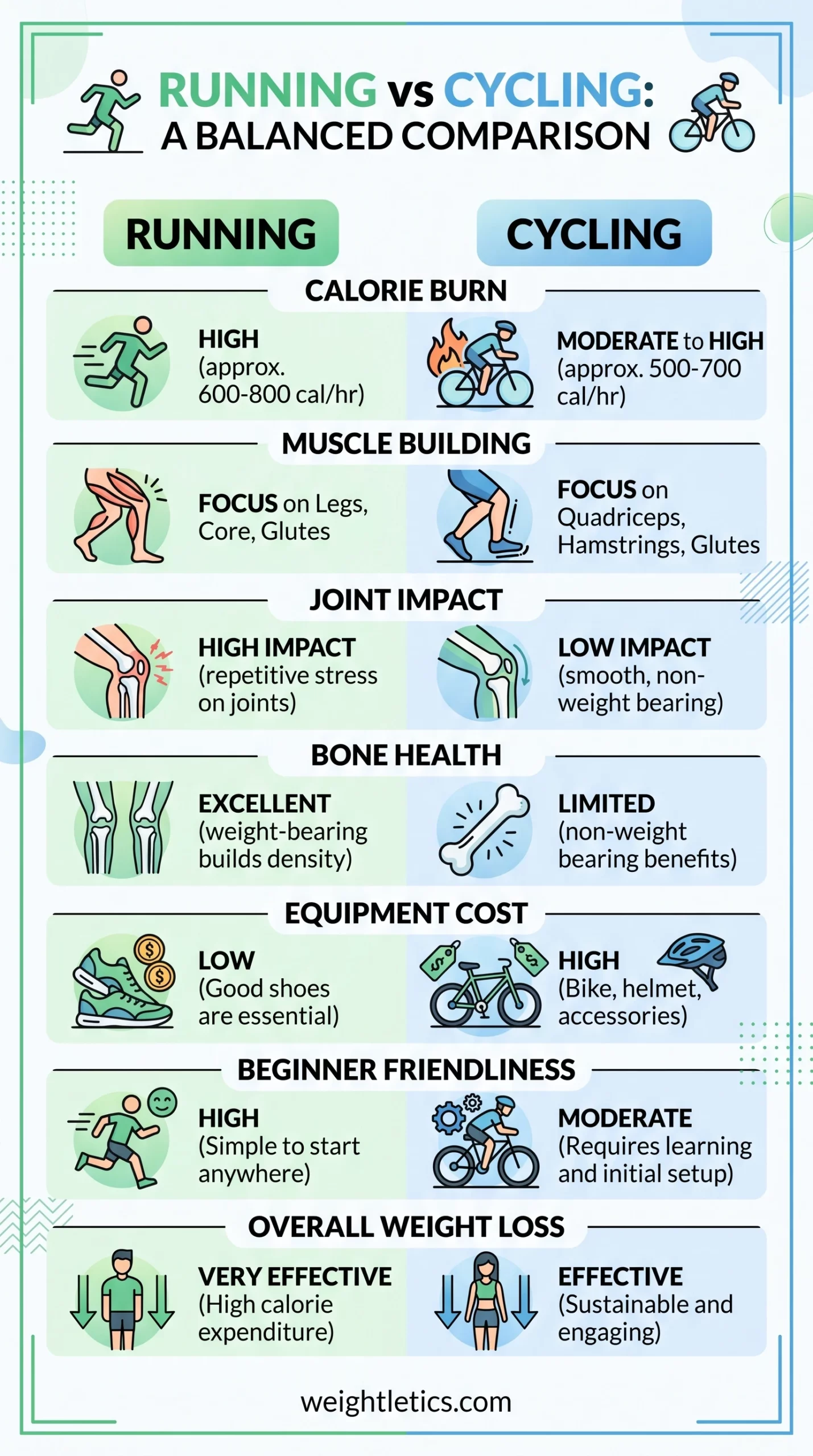
If you want to burn the most calories in the shortest time, running is hard to beat. It’s great for people with tight schedules or those who love training for races like 5Ks or half marathons.
Cycling might be the better pick if you’re overweight, recovering from injury, have joint issues, or just enjoy spending longer stretches moving without much discomfort.
Quick Takeaway
Running burns more calories in less time, while cycling is often easier to sustain for longer workouts. The best exercise for weight loss is the one you enjoy and can stick with consistently.
For a lot of people, combining both, maybe running two days and cycling two days a week, keeps things interesting and avoids the infamous workout rut.
Another benefit of mixing both activities is that it keeps your routine feeling fresh and gives you the chance to challenge different muscle groups.
The variety can keep motivation up so you won’t easily get bored with your fitness adventure.
Best for fast calorie burn: Running
Best for sustainable workouts: Cycling
Best overall: The one you can stick with consistently.
Running Is Ideal If You Want To
- Burn more calories in less time
- Train for races
- Improve bone health
- Exercise with minimal equipment
Cycling Is Ideal If You Want To
- Protect your joints
- Exercise for longer periods
- Recover from injury
- Build stronger leg muscles
Combine Both If You Want To
- Improve overall fitness
- Reduce injury risk
- Stay motivated
- Increase weekly calorie burn
Tips to Burn More Fat Whether You Run or Cycle
Maximise fat loss by combining regular cardio with strength training, progressive overload, adequate protein intake, quality sleep, and a sustainable calorie deficit. Long-term consistency has a greater impact on results than choosing one cardio exercise over another.
Improve Your Workouts
- Try interval training: Alternating between hard and easy efforts increases calorie burn both during and after your workout.
- Increase workout duration gradually: Slowly add duration or intensity to keep challenging your body in a safe way.
- Strength train 2–3 times per week: This boosts metabolism and preserves muscle tissue.
- Track your progress: Use apps, journals, or fitness watches to keep an eye on improvements.
Support Recovery
- Prioritize sleep: Sleep helps with fat burning and overall recovery.
- Hydrate well: Good hydration supports every aspect of recovery and performance.
- Eat plenty of protein: Helps your muscles recover and keeps hunger in check after tough workouts.
- Include rest days: These days are essential for your recovery.
Track Your Progress
- Monitor fitness improvements: The scale doesn’t tell the whole story. Measure your waist, note how your clothes fit, or use progress photos for a clearer picture.
- Don’t rely only on the scale: The scale is not the only indicator of your progress.
- Mingle with fellow exercisers: Connecting with others can give you added motivation and new ideas to keep progressing.
Focus on: Consistency
Don’t forget: Strength training
Biggest mistake: Expecting exercise alone to drive fat loss without paying attention to nutrition.
Quick Takeaway
Consistent training, progressive overload, strength training, adequate protein, quality sleep, and a calorie deficit will have a far greater impact on fat loss than choosing one cardio exercise over another.
Which Exercise Fits Your Goal?
Choose running if you want maximum calorie burn in less time, cycling if you need a low-impact workout, or combine both for balanced fitness and reduced injury risk. The best exercise is the one that matches your goals, abilities, and lifestyle.
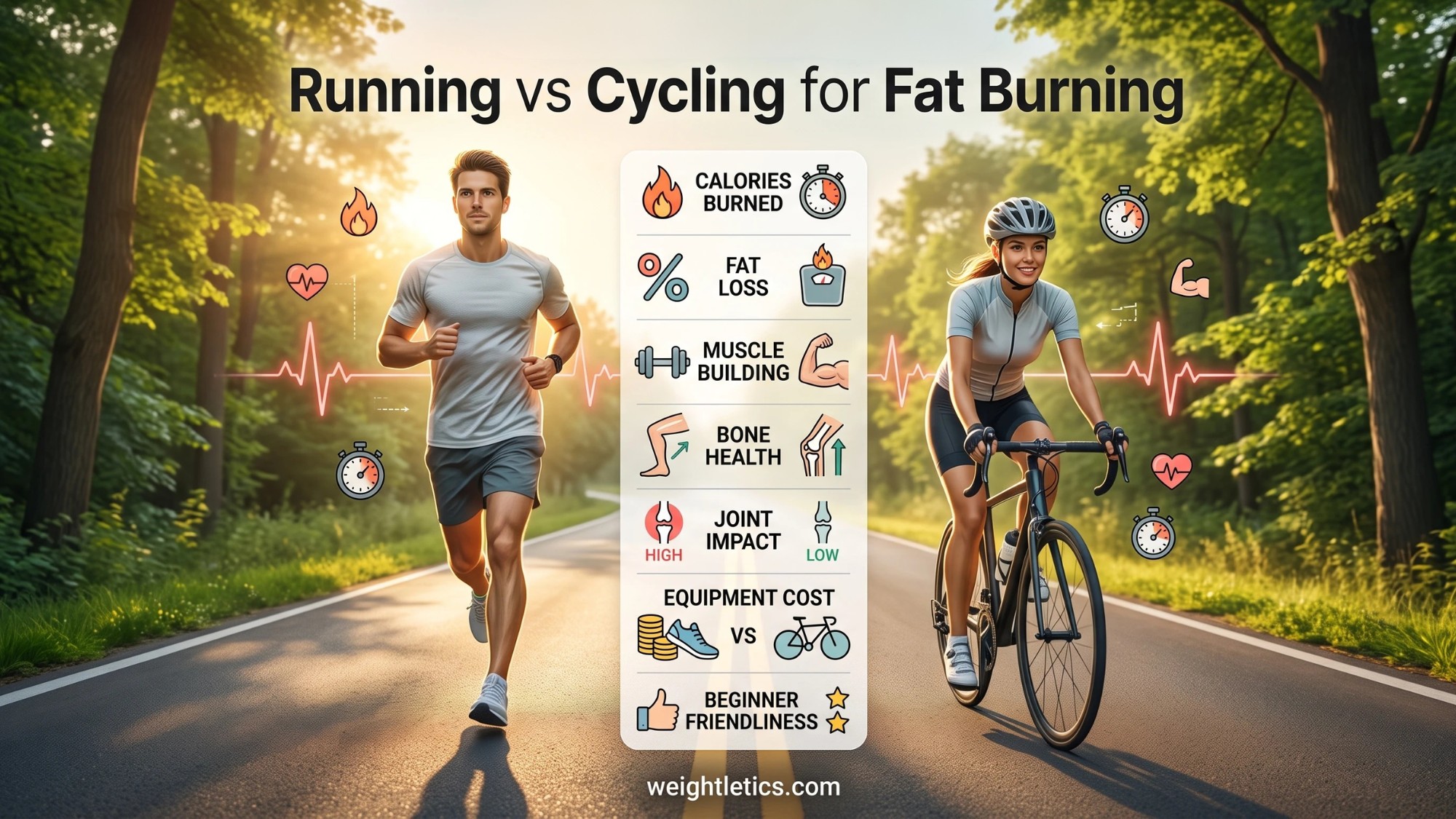
Short on time? Choose running.
Protecting your joints? Choose cycling.
Want the best overall fitness? Combine both.
Which Should You Choose?
The best exercise for fat burning isn’t necessarily the one that burns the most calories, it’s the one you’ll enjoy enough to do consistently. Your fitness level, goals, budget, and any physical limitations all play a role in determining which option is right for you.
Choose Running If
Running may be the better choice if you:
- Want to burn the most calories in the shortest amount of time.
- Have limited time for exercise during the week.
- Prefer a simple workout that only requires a good pair of running shoes.
- Want to improve bone density through weight-bearing exercise.
- Enjoy training for events like 5Ks, 10Ks, or marathons.
- Like the flexibility of running almost anywhere.
Although running burns more calories per minute, many beginners find they can comfortably cycle for twice as long. Over the course of an hour, the total calories burned can be surprisingly similar. Running is often the most efficient option for people looking to maximise calorie expenditure during shorter workouts.
Choose Cycling If
Cycling may be the better fit if you:
- Have knee, hip, or ankle pain.
- Are carrying extra weight and want a lower-impact workout.
- Prefer longer exercise sessions.
- Are recovering from a previous injury.
- Want to build stronger leg muscles while improving cardiovascular fitness.
- Enjoy exploring outdoors or using cycling as a way to commute.
Many beginners also find cycling easier to maintain because it places less stress on the joints and generally requires less recovery after each workout.
Choose Both If You Want the Best of Both Worlds
You don’t have to commit to just one activity. Combining running and cycling can provide a balanced approach to fat loss and overall fitness.
A mixed routine allows you to:
- Burn plenty of calories while reducing repetitive impact.
- Improve cardiovascular fitness in different ways.
- Lower your risk of overuse injuries.
- Train more consistently throughout the week.
- Add variety that helps keep exercise enjoyable.
For many people, alternating between running and cycling is the most sustainable strategy because it combines the calorie-burning efficiency of running with the joint-friendly benefits of cycling.
Quick Takeaway
There isn’t a single “best” option for everyone. Choose running, cycling, or a combination of both based on your goals, fitness level, joint health, and the activity you’re most likely to maintain over the long term.
The Best Choice Depends on Your Goals
Here’s a quick guide to help you decide:
| If your goal is | Best Choice |
|---|---|
| Burn the most calories in less time | Running |
| Protect your joints | Cycling |
| Build stronger leg muscles | Cycling |
| Improve bone health | Running |
| Exercise on a budget | Running |
| Recover from an injury | Cycling |
| Stay motivated with variety | Combine both |
| Long-term fat loss | The one you’ll do consistently |
No matter which option you choose, remember that fat loss ultimately comes down to maintaining a calorie deficit over time. Both running and cycling can help you achieve that goal when combined with a balanced diet, adequate recovery, and a routine you can maintain for the long term.
Stay updated with the Weightletics publication for natural health, wellness, tips, and more.
Frequently Asked Questions
Is cycling better than running for weight loss?
Both can be effective, but running usually burns more calories in less time. Cycling may be easier to stick with long-term and is friendlier for your joints.
Can I alternate running and cycling?
Absolutely! Alternating helps prevent boredom, reduces your risk of overuse injuries, and can keep you motivated over time.
Is cycling enough to lose weight without dieting?
Some people can drop pounds with cycling alone, especially if riding long or intense sessions. But for most, a combo of cycling and some attention to their eating habits speeds up fat loss noticeably.
Which burns more belly fat?
Neither one targets belly fat specifically. As your overall body fat decreases, you’ll lose it in your belly too. Consistency matters much more than the specific activity.
Should I run or cycle every day?
Daily movement is good, but both running and cycling need some breaks for recovery. Three to five sessions per week is plenty for most people. Mix easy and hard days and let your body rest as needed.
Key Takeaways
- Running burns more calories per minute.
- Cycling is easier on the joints.
- Both support fat loss when combined with a calorie deficit.
- Cycling builds more leg muscle.
- Running improves bone strength.
- The best exercise is the one you can maintain consistently.
Final Verdict
If your goal is maximum calorie burn in the shortest amount of time, running is usually the better choice. If you prefer longer, low-impact workouts that are easier on your joints, cycling may be the smarter option.
For many people, combining both activities delivers the best balance of fat loss, fitness, recovery, and long-term consistency. Ultimately, the most effective exercise is the one you’ll enjoy enough to keep doing week after week.
Running burns more calories quickly, but cycling is often easier for beginners, people dealing with injuries, or anyone who prefers long, steady workouts. Both are great for burning fat, building fitness, and keeping weight off, as long as you combine them with a sensible eating plan.
The best choice really boils down to which one you actually enjoy and can keep doing without dreading your workouts each week. That’s what brings real results over the long haul.
Best for calorie burn: Running
Best for joint health: Cycling
Best for lasting fat loss: The exercise you enjoy enough to do consistently
Quick Takeaway
Both running and cycling are excellent fat-burning exercises. Running offers greater calorie burn per minute, while cycling provides a lower-impact alternative that’s easier on the joints. The most effective choice is the one you’ll continue doing consistently.
Running Is Best If You Want
- Maximum calorie burn
- Better bone health
- Lower equipment costs
- Quick, efficient workouts
Cycling Is Best If You Want
- Lower-impact exercise
- Better joint protection
- Longer workouts
- Stronger leg muscles
You Can’t Go Wrong If You
- Enjoy your workouts
- Stay consistent
- Maintain a calorie deficit
- Support your training with good nutrition
If your goal is maximum calorie burn in the shortest amount of time, running is usually the better choice. If you prefer longer, low-impact workouts that are easier on your joints, cycling may be the smarter option.
For many people, combining both activities delivers the best balance of fat loss, fitness, recovery, and long-term consistency. Ultimately, the most effective exercise is the one you’ll enjoy enough to keep doing week after week.
References
American College of Sports Medicine – ACSM’s Guidelines for Exercise Testing and Prescription
Centers for Disease Control and Prevention – Healthy Weight, Nutrition, and Physical Activity
Compendium of Physical Activities – MET Values for Physical Activities
Harvard Health Publishing – Calories Burned Calculator
International Society of Sports Nutrition – Position Stand: Protein and Exercise
International Society of Sports Nutrition – Position Stand: Nutrient Timing
National Osteoporosis Foundation – Exercise for Bone Health
National Sleep Foundation – Healthy Sleep Recommendations
Note: This article is based on current exercise science, peer-reviewed research, and recommendations from recognised health organisations. It is intended for educational purposes and should not replace personalised medical advice.