 Dany
Dany Core exercises strengthen the muscles around your abdomen, lower back, and hips to improve stability, posture, and overall strength. The most effective core workout routine combines activation, stability, strength, and dynamic movements, helping prevent injuries and support fat loss when paired with proper nutrition and full-body training.
Building a strong, stable core doesn’t just make your abs look great, it’s super important for keeping your body moving well, supporting your lower back, and helping with fat loss when combined with good nutrition and regular exercise.
Putting together the right core workout can feel confusing, so I’m breaking down 50 of my favorite core exercises, grouped by skill level and focus. These core exercises and core workouts target the muscles around your midsection, helping improve strength, stability, and posture. Whether you’re looking for core exercises at home, core exercises for beginners, or building the best core workout routine, this guide covers everything you need to train effectively.
Whether you’re just getting started or you’ve been training for years, you’ll find moves in here that will challenge your core, improve balance, and kick your workouts up a notch.
Who This Guide Is For
- Beginners starting core training
- Intermediate lifters building strength
- Advanced athletes improving performance
- Anyone wanting a stronger core at home
TL;DR
Core exercises keep your whole body strong, help prevent injuries, and play a big role in fat loss plans. The right core workout routine combines activation, stability, strength, and dynamic moves, with progressions for every level. Mixing up your core work and doing it with proper form matters much more than endless crunches or situps.
What Are Core Exercises and Why Are They Important?
Core exercises strengthen the muscles around the midsection, including abs, lower back, pelvis, and hips. They improve spinal stability, posture, balance, and overall movement efficiency. A strong core helps prevent injuries, reduces back pain, supports athletic performance, and enhances the effectiveness of fat-burning workouts.
Core exercises and core workouts target the muscles around your midsection, including your abs, lower back, pelvis and hips. These muscles are your body’s support crew. They keep your spine safe, improve your posture, and boost your ability to move, run, jump, and even lift.
Keeping your core strong is really important for:
- Reducing back pain and discomfort
- Keeping your posture in check (no more slouching at the computer!)
- Speeding up progress in workouts and sports
- Getting the most out of fat-burning workouts
A healthy core isn’t all about “six-pack abs.” It’s about keeping your spine safe and your movements smooth and pain-free.
Core Training Truth Most People Miss
Most people think core training is about building visible abs, but in reality, your core’s main job is to stabilize your spine and transfer force through your body.
In practice, this means exercises like planks and dead bugs often deliver better long-term results than high-rep crunches, especially for posture, strength, and injury prevention.
What Research Says About Core Training
Studies in sports science show that core stability training can significantly improve balance, coordination, and injury prevention. Research published in the Journal of Strength and Conditioning Research has found that athletes who include structured core training improve functional movement and reduce the risk of lower back injuries.
This is why modern core workouts focus less on high-rep crunches and more on controlled, stability-based movements.
Subscribe and get your FREE Supplements Checklist
50 Best Core Exercises (By Category)
This article categorizes 50 core exercises by type and skill level: activation, stability, strength, rotational, functional/dynamic, and advanced. Each category targets specific muscle groups to develop core stability, strength, and control. The exercises provide scalable options for beginners through advanced trainees and can be included in home or gym routines.
This list includes the best core strengthening exercises, from simple core exercises for beginners to advanced movements. Whether you’re doing a quick core workout at home or building a full training plan, these exercises will help you develop strength, stability, and control.
The 5 Types of Core Exercises
- Activation exercises
- Stability exercises
- Strength exercises
- Rotational exercises
- Functional and dynamic exercises
Why Most Core Workouts Don’t Work
A common mistake is skipping straight to advanced or high-rep ab exercises without building proper stability first.
In my experience, this leads to weak core control, lower back strain, and slower progress. The real key is progression: activation first, then stability, then strength, and only then dynamic or advanced movements.
1. Core Activation Exercises (Beginner Foundation)
Before you jump into complex moves, it’s smart to wake up your deep core muscles and learn how to properly brace your abs. These moves look simple, but they’re powerful for building control.
- Dead Bug – Improves coordination and core stability while protecting the lower back
- Bird Dog – Builds balance and core control by engaging opposite arm and leg movement.
- Glute Bridge – Activates glutes and supports lower back stability while strengthening the posterior chain.
- Pelvic Tilt – Teaches proper core engagement and helps reduce lower back strain.
- Heel Slides – Strengthens deep core muscles while maintaining spinal stability.
- Marching Bridge – Adds instability to the bridge position to challenge core and glutes.
- Supine Toe Taps – Engages lower abs while maintaining a stable spine position.
- Abdominal Bracing – Trains your core to stabilize the spine during movement and lifting.
Tip: Slow, controlled movement makes these way more effective than just rushing through reps. Focus on steady breathing and activating your midsection.
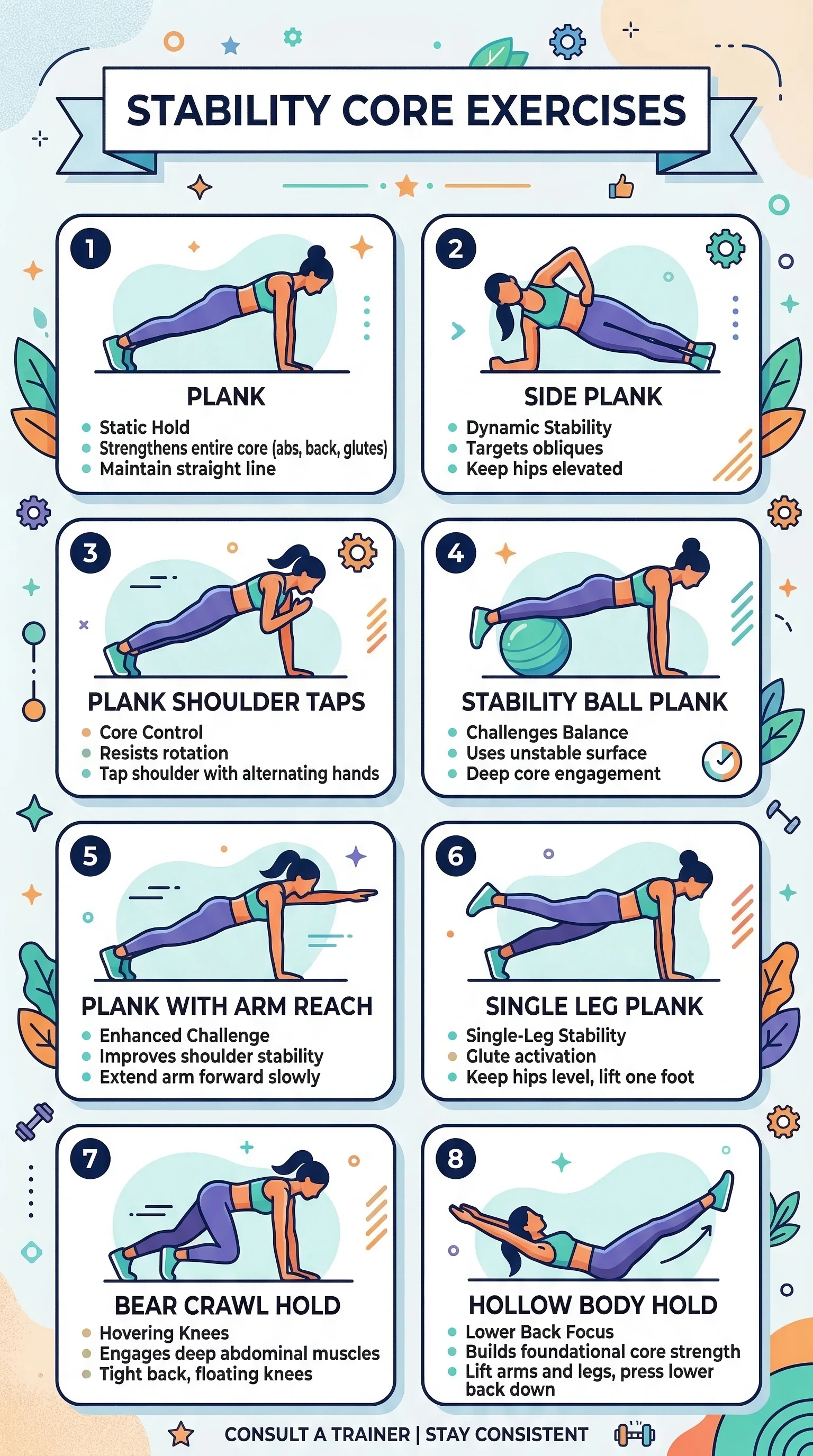
2. Stability Core Exercises
Training your core for stability teaches your abs and back to resist rotation, keep your spine steady, and balance your body. These are my favorite moves for improving balance and avoiding injuries.
- Plank – Builds full core strength and teaches proper bracing
- Side Plank – Targets obliques and improves lateral core stability.
- Plank Shoulder Taps – Challenges balance and anti-rotation core strength.
- Stability Ball Plank – Increases core activation by adding instability to a traditional plank.
- Plank with Arm Reach – Improves coordination and forces the core to resist rotation.
- Single Leg Plank – Enhances balance and increases core engagement through instability.
- Bear Crawl Hold – Strengthens the entire core while improving coordination and control.
- Hollow Body Hold – Develops deep core tension and full-body stability.
I’ve used these core exercises in my own training and with clients to build strength, improve posture, and reduce back pain.
These exercises are great if you want better posture or need to keep your back healthy during heavy lifting or sports. They’re also perfect for building control before adding resistance or more dynamic motions.
One common pattern is that people who start with activation and stability work (instead of jumping straight into crunches) report less lower back discomfort and better control during workouts. For many, this also leads to stronger lifts and better overall movement in daily life.
Unexpected Benefit of Core Training
One benefit people don’t expect is how much core training improves overall movement.
In many cases, stronger core stability leads to better performance in exercises like squats, deadlifts, and even running, because your body becomes more efficient at transferring force.
Real-World Results From Core Training
In my own training and when working with clients, I’ve consistently seen noticeable improvements in core strength and posture within 3–4 weeks of focusing on stability exercises like planks, bird dogs, and dead bugs.
3. Core Strength Exercises
Strength moves add muscle, make your abs pop, and build a solid core for everything else you do. These are the classic ab burners, but they’re not just for show, they add real functional strength.
- Crunch – Targets upper abdominal muscles for basic core strength.
- Reverse Crunch – Focuses on lower abs by lifting the hips toward the chest.
- Bicycle Crunch – Combines rotation and flexion to engage both abs and obliques.
- Leg Raise (lying or hanging) – Strengthens lower abs and hip flexors.
- Hanging Knee Raise – Builds core strength while improving grip and upper body stability.
- V-Up – Engages both upper and lower abs in a dynamic movement.
- Sit-Up – Trains full abdominal flexion and overall core strength.
- Toe Touch Crunch – Targets upper abs with a focus on controlled contraction.
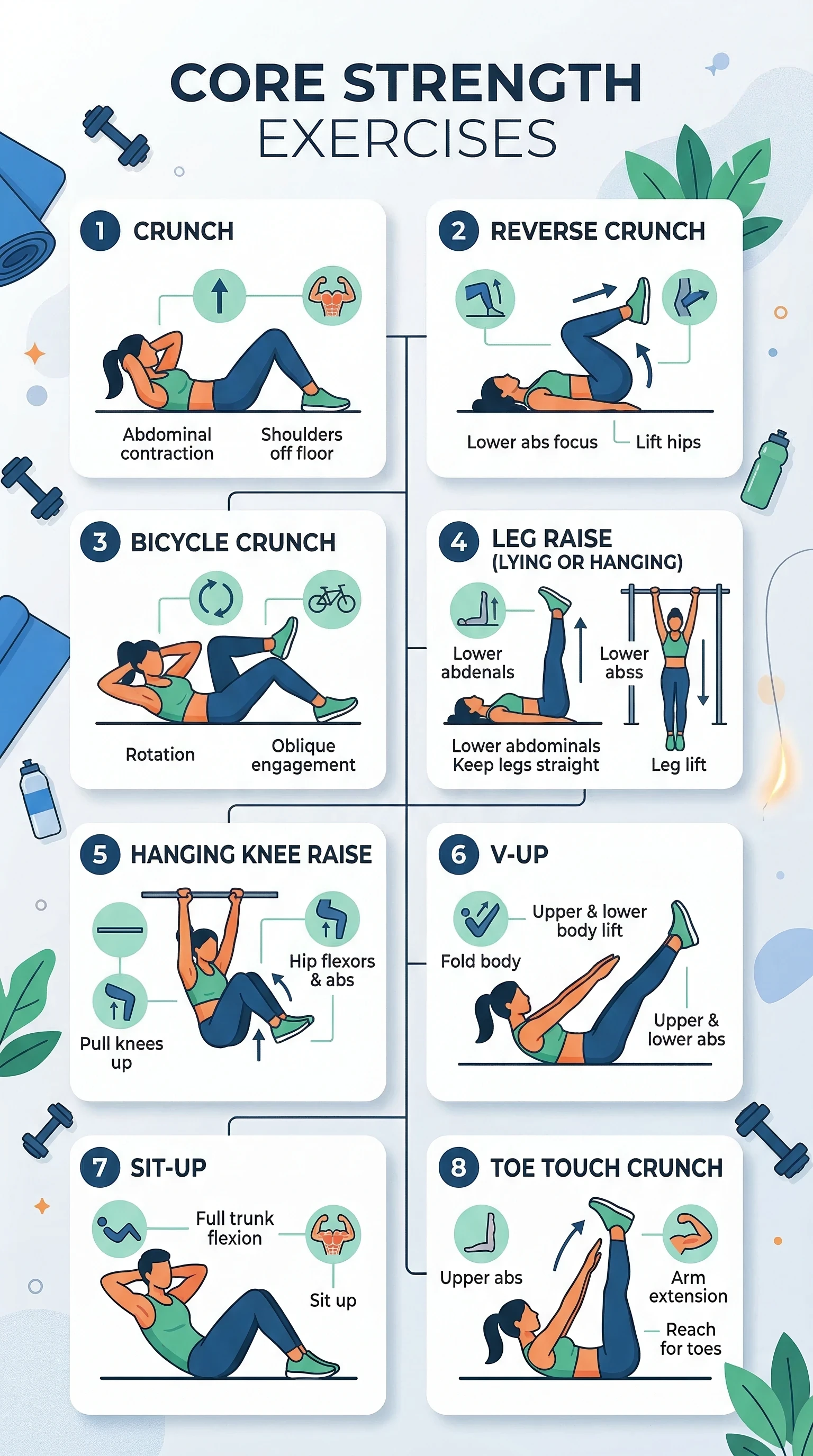
Aim to move with control. Using momentum makes these less effective and puts more stress on your neck or hips, always focus on quality reps over quantity.
Research published in the Journal of Strength and Conditioning Research shows that core stability training improves balance and reduces injury risk.
4. Oblique & Rotational Exercises
Your obliques run along the sides of your abs and help you twist, turn, and stabilize. Here are my top picks for training these muscle groups for a functionally strong core.
- Russian Twist – Strengthens obliques through controlled rotational movement.
- Standing Oblique Crunch – Engages side abs while improving balance and coordination.
- Woodchopper – Mimics real-life rotation and builds functional core strength.
- Side Plank Hip Dip – Adds movement to side plank for deeper oblique activation.
- Bicycle Twist – Targets obliques with a twisting crunch motion.
- Cable Rotation – Builds controlled rotational strength using resistance.
- Windshield Wiper – Challenges core stability and rotational control through leg movement.
- Oblique V-Up – Combines side crunch and leg lift for intense oblique activation.
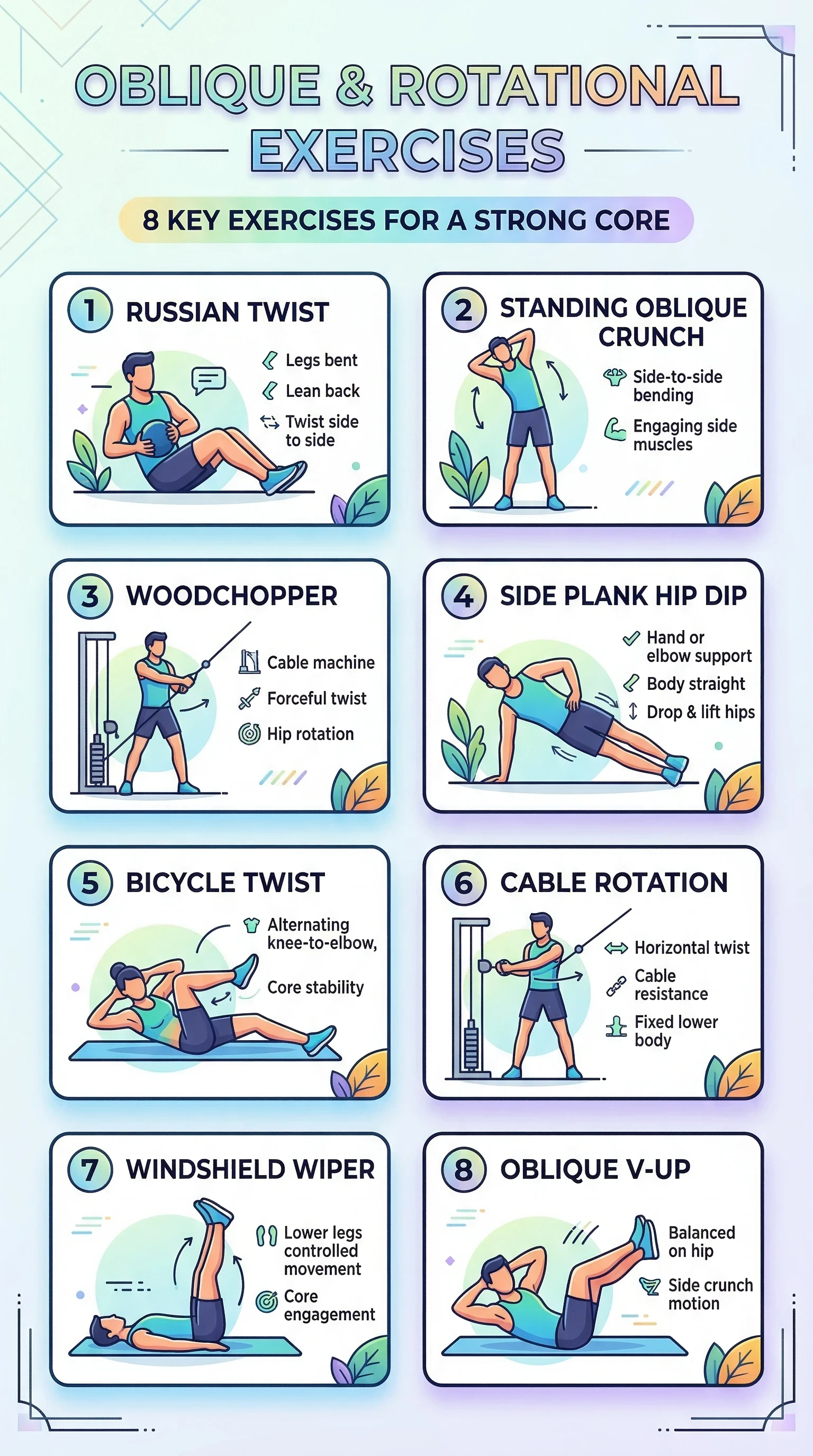
Training your obliques and doing ant-rotation work sculpts your sides and improves your movement in everyday life. Rotational strength is important in sports and can help you move more efficiently overall.
5. Functional & Dynamic Core Exercises
Functional core exercises blend strength, balance, and calorie burn. These mimic daily movement patterns and help with fat loss by increasing your heart rate. I love adding these for a real challenge, and because they make you sweat.
- Mountain Climber – Combines cardio and core engagement for fat-burning workouts.
- Plank Jack – Adds a jumping motion to plank for dynamic core activation.
- Burpee (with plank) – Full-body exercise that heavily engages the core.
- High Knees – Improves coordination and core stability while elevating heart rate.
- Kettlebell Swing – Builds explosive power while engaging the core for stability.
- Medicine Ball Slam – Develops power and core strength through explosive movement.
- Turkish Get-Up – Full-body movement that builds strength, coordination, and stability.
- Battle Rope Slam – Engages the core dynamically while increasing cardiovascular intensity.
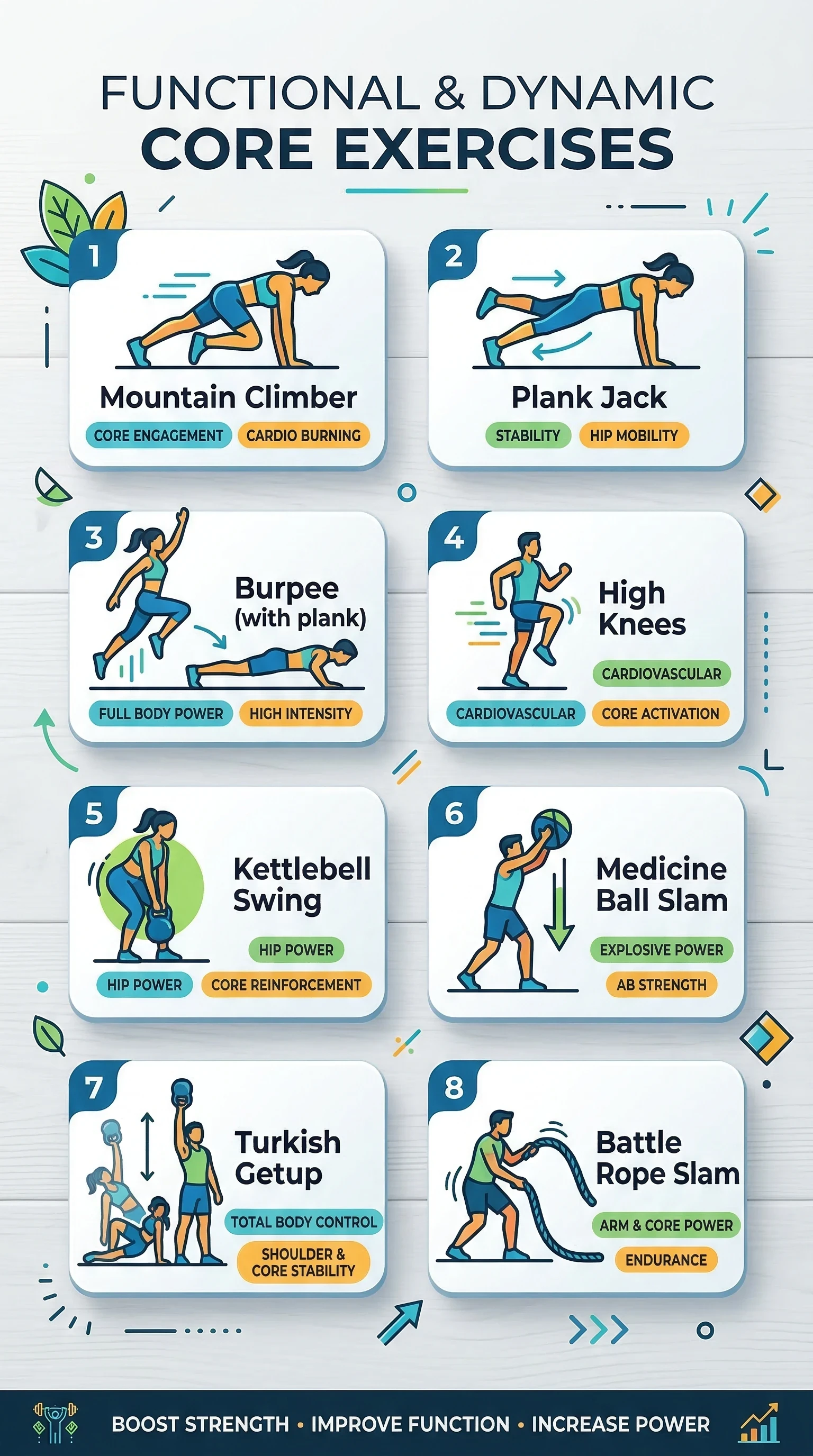
Most of these are full body combined with core work, making them great for getting sweaty and burning extra calories. They’re perfect if you want to add some variety to your routine.
Wondering how to actually get fat loss with core training? Here’s what works:
- Combine your core workouts with big compound lifts like squats and deadlifts for best calorie burn.
- Keep your diet in check, fat loss comes mostly from eating fewer calories than you burn.
- Stick with the basics, but stay consistent!
The Truth About Core Exercises and Fat Loss
Core exercises alone won’t burn belly fat, but they play a key supporting role.
From what I’ve seen, combining core training with full-body movements like mountain climbers or kettlebell swings increases overall calorie burn while strengthening the midsection. The real results come from pairing core work with proper nutrition and consistent training.
According to the American Council on Exercise (ACE), functional core exercises are more effective than isolated ab movements for overall strength.
6. Advanced Core Exercises
Ready to take it up a notch? Advanced exercises demand total body strength and stability. These are best for athletes or anyone who’s mastered the basics and is looking for the next challenge.
- Dragon Flag – Advanced movement that requires full-body tension and core control.
- L-Sit Hold – Builds isometric core strength and hip flexor endurance.
- Hanging Windshield Wiper – Combines hanging strength with rotational core control.
- Ab Wheel Rollout – One of the most effective exercises for building deep core strength.
- Decline Sit-Up (weighted) – Increases resistance for greater abdominal strength gains.
- Weighted Plank – Adds load to a plank to intensify core activation.
- Toe to Bar – Advanced hanging movement targeting lower abs and grip strength.
- Human Flag (progression) – Extreme core and upper body strength exercise requiring full-body control.
- Front Lever Hold – Develops elite-level core strength and body tension.
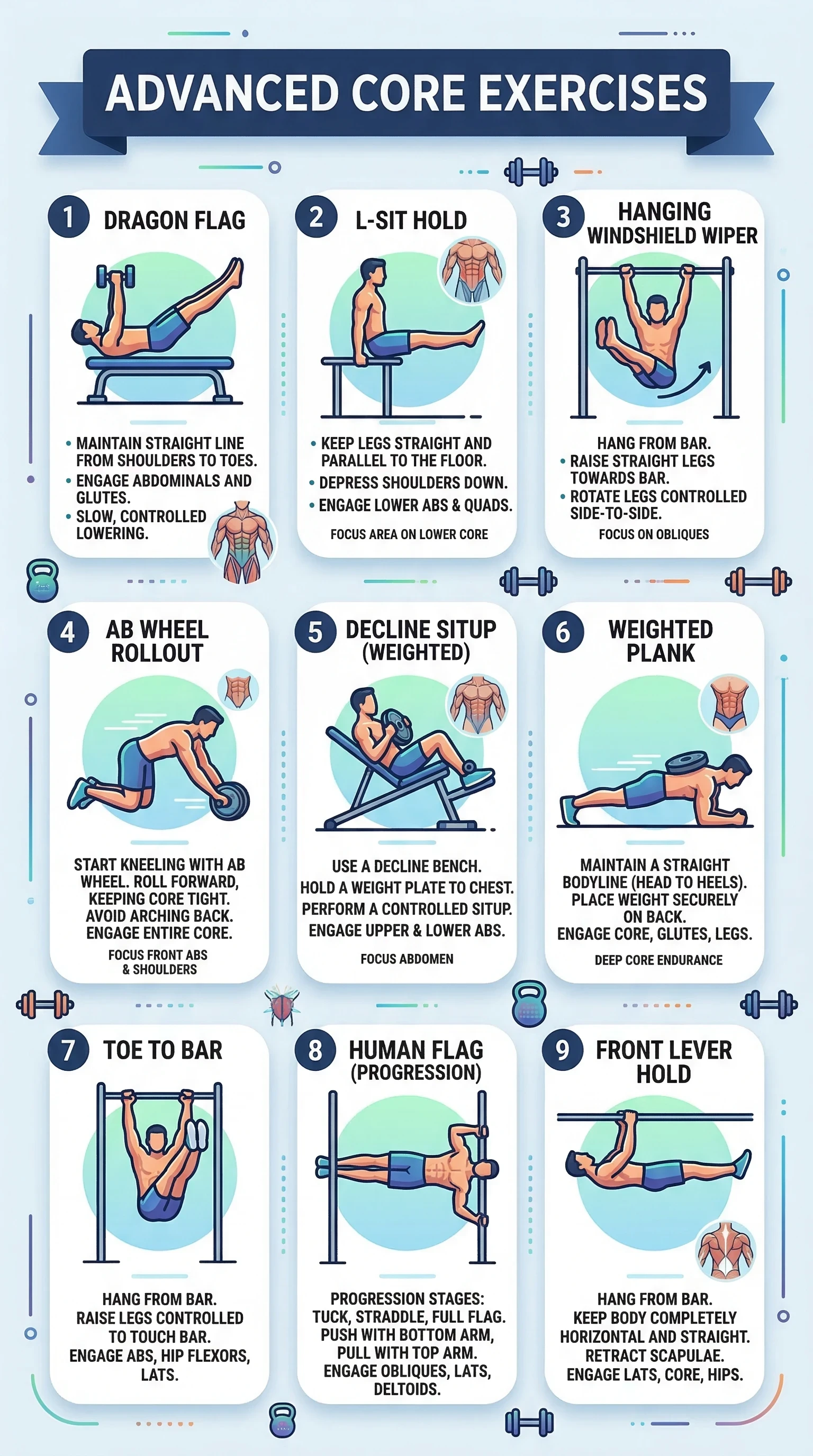
Only try these if you’ve built up a solid foundation and don’t have any nagging injuries. Make sure you warm up thoroughly before getting into these harder moves.
What Makes Advanced Core Exercises Different
Advanced core exercises aren’t just harder, they require full-body tension and precise control.
Many people try to rush into moves like dragon flags or front lever holds, but without proper foundational strength, these exercises become ineffective or risky. True progress comes from mastering the basics first.
How to Build the Best Core Workout Routine
- Choose 1 activation exercise
- Add 2 stability exercises
- Include 2 strength exercises
- Finish with 1 dynamic movement
Expert Insight: Why Most Core Workouts Fail
One of the biggest mistakes I see is people focusing only on visible ab exercises like crunches and sit-ups, while completely ignoring deep core muscles.
In practice, this often leads to weaker stability, poor posture, and even back pain. The most effective core workouts always start with activation and stability before progressing to strength and dynamic movements.
How to Choose the Right Core Exercises for Your Fitness Level
Selecting core exercises depends on skill, goals, and progression. Beginners should focus on activation and stability; intermediate trainees add strength and rotational moves, and advanced trainees incorporate dynamic, weighted, or complex exercises. Structured progression ensures safety, avoids plateaus, and maximizes core development.
Knowing which exercises to pick comes down to your level and goals. If you’re new, stick to the first two categories and add more as you build confidence and control. Here’s a quick breakdown:
- Beginner: Focus on activation plus stability moves.
- Intermediate: Start adding strength and oblique exercises.
- Advanced: Go for dynamic, weighted, and advanced strength moves.
A balanced routine often looks like this:
- 1 activation exercise
- 2 stability exercises
- 2 strength exercises
- 1 dynamic or functional exercise
Rotating your exercises every few weeks keeps things fun and helps avoid plateaus. If you ever feel bored or like you’ve stopped progressing, try mixing in some new moves from each category or playing with the sequence and difficulty.
Sample Core Workout Plan for Beginners to Advanced
The sample plan provides beginner, intermediate, and advanced circuits combining activation, stability, strength, and dynamic exercises. Workouts can be performed at home or in the gym, with repetitions and durations scaled for skill level, emphasizing proper form, consistency, and gradual progression.
If you’re short on time, simple core exercises at home can still deliver great results. Here are a few core workouts for different fitness levels. Rest as needed between exercises, and always focus on good form over speed or heavy weights. For each workout, feel free to repeat the circuit 2–3 times if you have time and energy.
Beginner (10–15 min):
- Dead Bug – 10 reps each side
- Plank – 20 seconds
- Glute Bridge – 12 reps
Intermediate (15–20 min):
- Plank – 30 seconds
- Bicycle Crunch – 15 reps each side
- Russian Twist – 20 reps each side
- Leg Raise – 12 reps
Advanced (20–30 min):
- Hanging Leg Raise – 12 reps
- Ab Wheel Rollout – 10 reps
- Mountain Climber – 30 seconds
- Side Plank – 30 seconds per side
If you want to keep things interesting, mix and match these exercises throughout the week or combine favorites from different levels for a custom core blast.
Quick Start Core Routine
- Dead Bug – 10 reps
- Plank – 20 sec
- Glute Bridge – 12 reps
- Repeat 2x
The Core Progression Rule That Changes Everything
One pattern I’ve seen repeatedly is that people plateau when they treat all core exercises the same.
The biggest improvements happen when you progress through stages, starting with control-based movements and gradually adding load, instability, or speed. Skipping this progression is one of the main reasons people stop seeing results.
Case Example: Beginner Core Progress
A beginner client I worked with struggled with lower back discomfort and couldn’t hold a plank for more than 15 seconds. By focusing on simple activation exercises like dead bugs and glute bridges for two weeks, they were able to improve plank time to over 45 seconds and reported less back tightness during daily activities.
This shows how starting with the right foundation can quickly improve both strength and comfort.
FAQ
Should you train core muscles every day?
Abs, like every muscle, get stronger with rest. Give yourself at least one day off between challenging core sessions to let the muscles recover and grow stronger.
What are the best core exercises for beginners?
The best core exercises for beginners focus on stability and control rather than intensity. Moves like dead bugs, bird dogs, glute bridges, and planks help build a strong foundation by activating deep core muscles while protecting the lower back and improving posture.
Why do my neck and back hurt with ab exercises?
Feeling tension means you might be using momentum or straining your neck. Focus on smaller movements, and keep your lower back gently pressing into the floor during crunches and raises. If discomfort continues, consider consulting with a fitness professional to spot any form issues.
Can core work really help with lower back pain?
Yes, especially if you pick the right moves and focus on proper form. Start with activation and stability work before doing hard flexion or weighted stuff. Avoid any exercises that cause discomfort and progress as you build strength.
Common Core Training Mistakes
Typical mistakes include overtraining abs, neglecting deep core muscles, using momentum instead of control, and focusing only on crunches. Avoiding these errors ensures balanced core development, reduces injury risk, and maximizes the effectiveness of core workouts across all skill levels.
- Doing abs every day. Muscles need time to recover and get stronger with rest.
- Ignoring deep core muscles like your transverse abdominis can keep your midsection weak and unbalanced.
- Using fast, sloppy movement for reps instead of slow, controlled work can lead to bad habits and injuries.
- Only sticking to crunches or situps and skipping the rest. Variety matters for a balanced, strong core.
Why These Mistakes Matter
Many people think doing hundreds of crunches will build a strong core, but research and real-world results show that this approach often leads to muscle imbalances and limited progress.
Focusing on controlled, full-core engagement exercises delivers better long-term strength, improved posture, and reduced injury risk compared to high-repetition ab-only routines.
Final Thoughts
Core training supports spinal health, posture, and overall movement efficiency beyond aesthetic goals. Progressing through activation, stability, strength, and dynamic exercises gradually ensures safe, effective results. Consistency, variety, and proper form are key to long-term improvements and functional core strength.
Training your core is about more than just chasing visible abs. It helps your body move better, keeps pain at bay, and fits into any well-rounded workout routine. Start with the basics, progress slowly, and don’t be afraid to mix things up. Your spine, posture, and results will thank you for it.
If you have a favorite core exercise or tip, I’d love to hear about it! Share what works for you in the comments or with your workout crew, you’ll help everyone get stronger together.
Stay updated with the Weightletics newsletter for new exercises, tips, and full workout plans.

Disclaimer: This content is for educational purposes and does not replace professional medical or fitness advice.